Laparoscopic Surgery
Laparoscopic Surgery in Ahmedabad
Most abdominal operations that once required a long cut across the belly can now be done through three or four incisions, each under a centimetre wide. This is laparoscopic surgery – a camera and a set of long, slender instruments do the work that a surgeon’s hand once had to do directly.
Dr. Vasistha Jajal performs laparoscopic surgery for gallbladder disease, hernia, appendicitis, reflux, and a range of hepato-pancreato-biliary conditions at his practice in Ahmedabad. Over more than 2,000 operations, the deciding factor in every case has been the same: whether the smaller approach gives the patient an outcome at least as good as open surgery, with less time spent recovering from the incision itself.
What "Laparoscopic" Actually Means?
Laparoscopic surgery replaces one long incision with a few small ones, using a camera and slim instruments to carry out the operation from outside the abdomen rather than through it.
Gas Space
The abdomen is gently inflated with carbon dioxide to create room to work between the organs and the abdominal wall.
Camera Entry
A thin tube carrying a laparoscope goes in through a small incision near the navel.
Screen-Guided View
The camera feed is projected onto a monitor, magnified several times over actual size.
Instrument Access
Two or three more small incisions let long, narrow instruments reach the surgical site.
Monitor-Based Surgery
The surgeon operates while watching the screen, not by looking directly into the abdomen a distinct skill built on 2D depth perception and instrument control.

A few centimetre-wide cuts replace one long incision, meaning less cutting through abdominal muscle.

Reduced muscle trauma means pain is milder and easier to manage in the days after surgery.

Patients are usually walking within a day and back to light activity within a week.

Smaller wounds mean less exposed tissue, which lowers the risk of surgical site infection.

When a Laparoscopic Approach Gets Recommended
Not every condition qualifies, and not every patient with a qualifying condition should have a laparoscopic operation. Dr. Jajal’s decision rests on three questions: how advanced is the disease, what does imaging show about scarring or anatomy, and does the patient have other health factors prior abdominal surgery, severe lung or heart disease, uncontrolled bleeding risk that change the calculation. Conditions regularly treated laparoscopically at this practice include:
- Gallbladder stones and gallbladder inflammation (cholecystitis)
- Appendicitis
- Inguinal, umbilical, and incisional hernia repair
- Gastroesophageal reflux disease (GERD) and hiatus hernia
- Diagnostic and staging procedures for suspected GI or HPB cancers
- Select liver and pancreatic conditions, depending on tumour location and size
- Colorectal resections in appropriate cases
When Should You See a Laparoscopic Surgeon?
Patients usually don’t seek laparoscopic surgery by name. They first notice a persistent or recurring abdominal problem, after which examination and imaging help determine whether surgery is needed and whether a laparoscopic approach is appropriate. These are some of the common concerns that may lead to a surgical evaluation:
Recurring Right Upper Abdominal Pain
Sudden Lower Right Abdominal Pain
Persistent Groin or Abdominal Bulge
Dr. Vasistha Jajal trained in gastrointestinal surgery through B. J. Medical College and Civil Hospital, Ahmedabad, two of the busiest public surgical training grounds in Gujarat, where high patient volume translates into repeated hands-on exposure to laparoscopic technique during residency. He secured the second rank in the All India Super Specialty Examination, which placed him at one of India’s established centres for gastrointestinal surgery for his super-specialty training in Hepato-Pancreato-Biliary and GI surgery.
Since then, he has completed more than 5,000 operations, with laparoscopic and robotic approaches forming the core of his gallbladder, hernia, and upper GI practice. For hepato-pancreato-biliary cases specifically, where anatomy is less forgiving and margins for error are smaller, his training included focused exposure to complex biliary and pancreatic surgery.
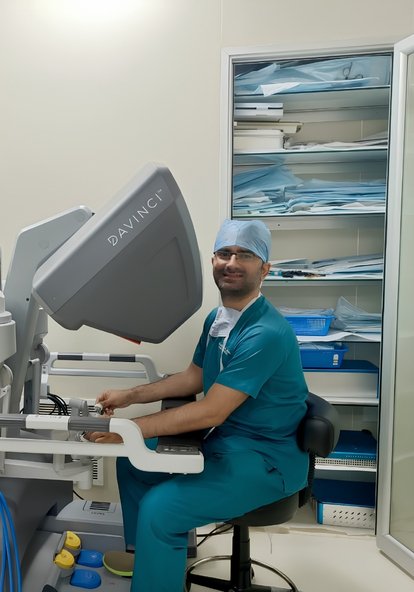
For select hernia, HPB, and colorectal cases, Dr. Jajal offers robotic-assisted surgery, which extends laparoscopic principles with wristed instrument movement and 3D visualisation. This is discussed case by case, it isn’t a universal upgrade over standard laparoscopy, and the choice depends on the specific anatomy and complexity involved.
What Sets This Laparoscopic Practice Apart
A closer look at the training, technique, and decision-making behind every laparoscopic procedure here.

Case Volume
Over 2,000 operations performed, with laparoscopic technique forming the core of daily surgical practice.
HPB Focus
Super-specialty training in hepato-pancreato-biliary surgery, beyond routine laparoscopic procedures.

Rank Credentials
Second rank nationally in the All India Super Specialty Examination during surgical training.

Conversion Honesty
Open surgery is chosen upfront when imaging shows it's safer, never treated as a fallback plan.

Robotic Access
Robotic-assisted surgery offered for select hernia, HPB, and colorectal cases needing finer control.

Direct Follow-Up
Post-operative review scheduled personally to check healing and discuss histopathology results.
What Patients Ask About Laparoscopic Surgery
Is laparoscopic surgery better than open surgery?
For suitable patients, laparoscopic surgery can offer smaller incisions, less abdominal muscle trauma, shorter hospital stays and faster return to normal activities. However, laparoscopic surgery is not appropriate for every condition, so the safest approach is decided after evaluating the disease, imaging and overall health.
How long does it take to recover from laparoscopic surgery?
Recovery varies according to the procedure and its complexity. Many patients undergoing straightforward gallbladder, appendix or hernia procedures can return to light daily activities within about a week, while strenuous exercise and heavy lifting may need to be avoided for several weeks.
How long do I need to stay in the hospital after laparoscopic surgery?
For uncomplicated laparoscopic gallbladder, appendix and hernia procedures, many patients can be discharged within 24 to 48 hours. The actual hospital stay depends on the operation, recovery after anaesthesia and the patient’s overall condition.
Is laparoscopic surgery performed under general anaesthesia?
Yes. Laparoscopic procedures are generally performed under general anaesthesia, with pre-operative fasting and medication instructions provided before the operation.
Is robotic surgery the same as laparoscopic surgery?
Robotic surgery is an advanced form of minimally invasive surgery that builds on laparoscopic principles. It provides wristed instrument movement and 3D visualisation in selected cases, but it is not automatically better than conventional laparoscopy. The appropriate technique depends on the patient’s condition and surgical anatomy.
Is Laparoscopic Surgery Right for You?
Get your condition evaluated by Dr. Vasistha Jajal and understand whether laparoscopic surgery is the right approach for your condition.