

Liver Tumor Treatment

Liver Tumor Treatment in Ahmedabad

Finding a liver tumor on a scan raises an immediate question, but “should this be removed” isn’t actually the first one worth answering. The first question is what kind of tumor it is –  benign growths found incidentally are common and often need nothing more than monitoring, while tumors with malignant features need a very different, more urgent pathway. Getting this distinction right, before any decision about surgery, is where liver tumor evaluation actually begins.

Dr. Vasistha Jajal evaluates and treats liver tumors ranging from benign cysts and haemangiomas that need no intervention, to primary liver cancers and tumors that have spread to the liver from elsewhere, where surgical removal (resection) becomes part of a broader treatment plan. 

What Liver Tumor Treatment Actually Involves

Liver tumor treatment begins with characterising the tumor precisely – its type, size, location, and relationship to major blood vessels since these factors, more than tumor presence alone, determine what treatment path makes sense.

Imaging Characterisation

CT or MRI with contrast identifies tumor type based on how it behaves during different imaging phases.

Biopsy When Needed

A tissue sample is taken when imaging alone can't confirm whether a tumor is benign or malignant.

Liver Function Assessment

Blood tests and imaging assess how well the remaining liver would function after any planned removal.

Resectability Review

Tumor location relative to major blood vessels determines whether surgical removal is technically safe.

Treatment Sequencing

Surgery, ablation, or non-surgical management is planned based on tumor type, size, and number.

Avoids Unnecessary Surgery

Correctly identifying benign tumors prevents surgery that carries no real benefit.

Protects Liver Function

Careful planning ensures enough healthy liver tissue remains after any resection.

Improves Cancer Outcomes

Timely, accurate diagnosis allows malignant tumors to be treated before further growth.

Reduces Bleeding Risk

Mapping blood vessel involvement beforehand allows safer surgical planning around them.

Each Tumour Type Needs a Different Plan

Liver tumors fall into distinct categories, and confusing them leads to either unnecessary intervention or dangerous delay.

Benign Tumors

Haemangiomas, liver cysts, and focal nodular hyperplasia among them are common incidental findings and are usually monitored rather than treated, unless they’re unusually large or causing symptoms.

Primary Liver Cancer

Hepatocellular carcinoma, most often arising in a liver already affected by chronic disease like hepatitis or cirrhosis) is evaluated for resectability based on tumor size, number, and how well the remaining liver is likely to function.

Secondary Liver Tumors

(Cancer that has spread to the liver from elsewhere, most often the colon) are evaluated differently treatment often combines liver-directed surgery with systemic treatment for the original cancer, planned alongside an oncology team.

Tumors involving Major Blood Vessels

Need particularly careful mapping, since vessel involvement can change a tumor from resectable to inoperable, or require a more complex surgical approach.

When Should You See a Specialist for Liver Tumour

Liver tumors, particularly in early stages, often produce no symptoms at all and are found incidentally during scans done for unrelated reasons. When symptoms do appear, they tend to reflect either the tumor’s size or its effect on liver function.

Discomfort or fullness in the upper right abdomen

Persistent fatigue without an otherwise clear cause

Unexplained weight loss over recent months

Abdominal swelling from fluid accumulation

Yellowing of skin or eyes suggesting liver dysfunction

A tumor found incidentally on unrelated imaging
Dr. Vasistha Jajal's Experience with Liver Tumor Cases

Dr. Vasistha Jajal’s hepato-pancreato-biliary super-specialty training, completed at one of India’s established centres for GI and HPB surgery following a second-rank result in the All India Super Specialty Examination, included focused exposure to liver resection planning assessing not just whether a tumor can technically be removed, but whether the remaining liver will function adequately afterward.

Across more than 5,000 operations, liver tumor cases are approached with this same distinction consistently applied: confirming tumor type and resectability carefully before recommending surgery, rather than treating tumor detection alone as sufficient reason for intervention.

Years of Experience
0 +
Surgeries Performed
4500 +
Key Surgical Areas
0 +
Start Your Surgical Journey in Three Simple Steps

Reach out to the clinic by phone or fill out the online consultation form.

Book Your Appointment

Choose a convenient consultation time and confirm your appointment.

Meet Dr. Vasistha Jajal for an evaluation and discuss your treatment options
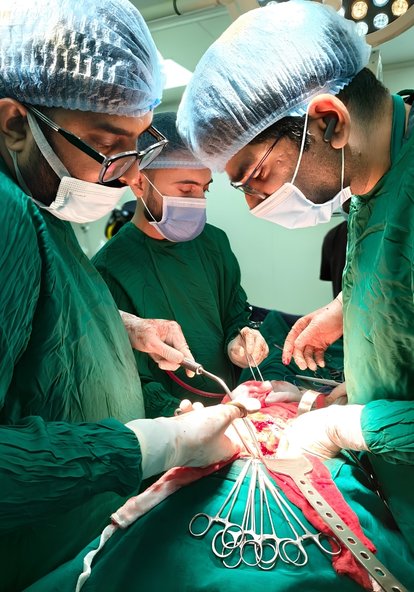

Inside the Operating Room

Liver resection surgery ranges considerably in scope, from removing a small segment to a more extensive resection involving a larger portion of the liver, depending on tumor size and location. Surgery typically takes two to five hours under general anaesthesia, with careful attention paid to controlling blood loss given the liver’s rich blood supply. Where appropriate, a laparoscopic approach is used for smaller, well-positioned tumors, while larger or more centrally located tumors, particularly those near major vessels, often require an open approach for adequate control and precision.

+91-96874 86618

What Sets This Liver Tumor Treatment Practice Apart

A look at how diagnostic precision, functional planning, and case-specific judgment shape outcomes in liver tumor care specifically.

Case Volume

Over 2,000 operations performed, including hepato-pancreato-biliary and liver resection procedures.
HPB Specialisation

HPB Specialisation Focused super-specialty training in hepato-pancreato-biliary surgery, including liver resection planning.

Rank Credentials

Second rank nationally in the All India Super Specialty Examination during surgical training.

Function-First Planning

Remaining liver function assessed carefully before deciding how much tissue can be removed.

Vessel Mapping
Care

Blood vessel involvement mapped in detail before any resection is planned or performed.

Oncology Coordination

Oncology Coordination Secondary liver tumor cases coordinated with oncology teams for combined treatment.

What Patients Ask About Liver Tumor Treatment

No, many liver tumors found incidentally are benign and simply monitored rather than treated.

Contrast imaging usually identifies tumor type based on its behaviour across imaging phases; a biopsy is used if unclear.

Yes, the liver has a significant capacity to regrow functional tissue over the weeks and months after resection.

No, it depends on tumor size, number, and location- larger or centrally located tumors often need an open approach.

Treatment usually combines liver-directed surgery with systemic treatment for the original cancer, planned with an oncology team.

Found a Liver Tumor on a Recent Scan?

A tumor detected incidentally on a scan for an unrelated reason isn't automatically cause for alarm, but it does need a proper evaluation to confirm what it actually is before deciding on next steps. Book a Consultation with Dr. Vasistha Jajal

About Us

Dr. Vasistha Jajal is a Gastrointestinal and Hepato-Pancreato-Biliary (HPB) Surgeon in Ahmedabad with 10+ years of experience in gastrointestinal surgery. His practice includes laparoscopic, robotic, HPB and gastrointestinal cancer surgery, along with endoscopic procedures. With 5,000+ gastrointestinal and hepatobiliary operations performed, he provides surgical evaluation and treatment for a wide range of digestive, liver, pancreas, gallbladder and bile duct conditions.

Copyright © 2026 Dr. Vasistha Jajal | Designed by EEG Technogeeks 

Scroll to Top